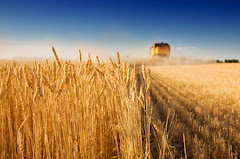
Although a number of crops are failing in Argentina, including corn and soy, wheat is also participating in the destructive drought that is crushing the entire agriculture sector of Argentina.
The commodity grain sector hasn't moved with the metals market, as demand for everything is down, even though people still need to eat, as well as their livestock.
This is particularly difficult for Argentina, who is one of the top exporters of grains in the world, and so depend on so much on it for the welfare of the country.
At this time things are so bad that farmers have given up trying to salvage their wheat crop, and instead are focusing on saving their cattle. Even if the cattle are saved, they will be difficult to breed because of the lack of food for them.
According to farmers in Argentina, wheat fields are as dried as they can be, with little hope of salvaging a wheat crop, as there is little to put in storage.
Unfortunately for everyone involved, the wheat planting, wheat yield and wheat harvest around the world has been huge, and so the drought in Argentina is hurting them without benefiting anyone else.
Even though farmers in the U.S. were hoping to get some of the trade usually done by Argentina with Brazil, it looks like it won't have much impact on wheat exports from the U.S., and so Argentines will be the ones to suffer.
So in spite of this, wheat futures aren't moving much because of this, although there was a slight move upward recently based on wheat news from the country. But it's not sustainable.
Weather predictions in the country are, as usual, contradictory, and so some say the drought will end with rain coming, and others say it won't amount to much. Either way, wheat farmers in Argentina, and its people, are in for a long struggle as grain prices continue to fall.
For Argentina, this is the worst year for drought and lack of rain since 1971, and even if there is a major change in the weather patterns, the wheat harvest will be way down, as wheat production grinds to a halt.
Along with the wheat crop, other crops suffering are corn and soy, with silos there to store the crops are in many cases empty or half full.
Even though soy is down, it is still on the positive side, and is projected to increase in production by 7 percent. The corn harvest will fall by about 27 percent, and wheat production will be hit the most from the poor growing season projected to plunge by 44 percent over the 2008-2009 harvesting season.
Grains are so scarce in the country, that the Argentine government is has even lowered the minimum weight requirements to slaughter cattle so the farmers can make some money off them before they are worthless or die.
It'll take some time to recover from this wheat disaster, as Argentina will suffer probably for a couple years or more trying to come back from this natural disaster.
In a normal year this would have boosted wheat prices tremendously, but the wheat harvest has been so plentiful globally, that it will easily absorb the losses without making a difference in wheat prices.
Showing posts with label Argentina Wheat. Show all posts
Showing posts with label Argentina Wheat. Show all posts
Sunday, January 25, 2009


Friday, November 21, 2008
U.S. Could Land Some Wheat Export Business from Brazil
There are some things that would have to be overcome in order for Brazil to import some U.S. wheat this year; something that has become rare since the agreement between several South American countries to sell grain between countries with no duty attached to the deals.
While Argentina usually supplies the bulk of wheat to Brazil, this year their production has fallen drastically from last year's 16 million tons to only 10.1 million this year. Of that, last year 10.5 million tons were exported to Brazil, and this year projections are for only 5.8 million tons to be available.
The major disruptions causing the lackluster production for Argentina has been dry weather and less acreage planted in wheat.
A key factor the attractiveness of exporting to Brazil for the U.S. is if Brazil drops its import tax. The U.S. is able to send a high quality wheat with low freight charges, giving them an advantage over its competitors.
If that doesn't happen, U.S. wheat exports don't look too good.
With India making over 2 million extra tons of wheat available for export in their region, and Russia winning North Africa and Middle East contracts, it makes it harder for the U.S. to compete, as there's an abundance of wheat available because of the record crop this year.
The USDA is once again expected to drop its wheat export estimates over the next several months.
While Argentina usually supplies the bulk of wheat to Brazil, this year their production has fallen drastically from last year's 16 million tons to only 10.1 million this year. Of that, last year 10.5 million tons were exported to Brazil, and this year projections are for only 5.8 million tons to be available.
The major disruptions causing the lackluster production for Argentina has been dry weather and less acreage planted in wheat.
A key factor the attractiveness of exporting to Brazil for the U.S. is if Brazil drops its import tax. The U.S. is able to send a high quality wheat with low freight charges, giving them an advantage over its competitors.
If that doesn't happen, U.S. wheat exports don't look too good.
With India making over 2 million extra tons of wheat available for export in their region, and Russia winning North Africa and Middle East contracts, it makes it harder for the U.S. to compete, as there's an abundance of wheat available because of the record crop this year.
The USDA is once again expected to drop its wheat export estimates over the next several months.
Monday, November 10, 2008
Where is Wheat Price Per Bushel Going in 2009
Wheat ending stocks for 2008-2009 are slightly higher than trade estimates of 594 million-bushel-average, as well as the 601 million-bushel average the USDA projected for October.
The overall global wheat production has risen, while some individual countries fluctuate. Argentina for example announced its production fell by 1 million metric tons to 11 million, while India has had such a good wheat harvest this year they're making two million tons of available for export.
Wheat supplies will also put competitive pressure on corn because of the large supply this year.
Because of the huge supply, there won't be much happening with wheat that will surprise anyone.
As far as prices, soft red winter wheat has "the most downside room; some of better classes can hold in a bit more strongly."
The global wheat market will continue to be bearish, even as drought conditions pressure certain countries like the Phillipines, Argentina and most recently China. Even with that pressure, the price for wheat per bushel in 2009 shouldn't be affected too much, and it shouldn't be counted on to push up wheat prices a bushel anytime soon.
There will be plenty of wheat for sale, and that will keep wheat prices per barrel down, as the huge wheat surplus this year, especially in the European Union and Black Sea region being major contributing factors. There has also been a huge wheat crop in Canada this year to add to the overall wheat picture.
Considering India wheat being so prolific this year as well, and you see how wheat prices per barrel in 2009 will struggle to rise, even when you take into account quality wheat. In these types of economic downturns, survival is more important than the protein content of wheat, and being able to afford the cost of food in general, and wheat in particular is the guiding factor behind where prices of wheat per barrel will lead to.
It's hard to tell how much wheat will be planted in 2009 as well, with fertilizer costs playing a big factor in the decision of whether to plant, and if wheat is planted, how much fertilizer can be used for the wheat and still be cost effective. Fertilizer prices have gone down some, but low wheat prices per barrel make it difficult to top dress wheat with nitrogen fertilizer and still be profitable in a meaningful way for those putting their wheat up for sale.
The most recent projections for wheat exports from the USDA stand at 210 million bushels, an extraordinary third less than 2008. And as of January 1, wheat sales have plunged by close to 40 percent, with only 158 million bushels sold in the U.S.
While there is some opportunity for wheat exports and wheat prices per barrel to rise in 2009, it will depend mostly on weather conditions for the U.S. wheat crop, along with the number of acres planted after a fairly poor year. The high protein sector may offer some opportunity for U.S. farmers, but wheat quality from other countries, and the above-mentioned factors will determine the price per bushel of wheat in 2009. There's no way of knowing at this time where all this will head, as weather is the key factor, and that of course has yet to be played out. Other countries have suffered quality wheat production, which could help wheat prices per bushel rise, but that will highly depend on the quality of wheat produced in the U.S., which again, will be determined by the weather conditions in the spring months of 2009.
The overall global wheat production has risen, while some individual countries fluctuate. Argentina for example announced its production fell by 1 million metric tons to 11 million, while India has had such a good wheat harvest this year they're making two million tons of available for export.
Wheat supplies will also put competitive pressure on corn because of the large supply this year.
Because of the huge supply, there won't be much happening with wheat that will surprise anyone.
As far as prices, soft red winter wheat has "the most downside room; some of better classes can hold in a bit more strongly."
The global wheat market will continue to be bearish, even as drought conditions pressure certain countries like the Phillipines, Argentina and most recently China. Even with that pressure, the price for wheat per bushel in 2009 shouldn't be affected too much, and it shouldn't be counted on to push up wheat prices a bushel anytime soon.
There will be plenty of wheat for sale, and that will keep wheat prices per barrel down, as the huge wheat surplus this year, especially in the European Union and Black Sea region being major contributing factors. There has also been a huge wheat crop in Canada this year to add to the overall wheat picture.
Considering India wheat being so prolific this year as well, and you see how wheat prices per barrel in 2009 will struggle to rise, even when you take into account quality wheat. In these types of economic downturns, survival is more important than the protein content of wheat, and being able to afford the cost of food in general, and wheat in particular is the guiding factor behind where prices of wheat per barrel will lead to.
It's hard to tell how much wheat will be planted in 2009 as well, with fertilizer costs playing a big factor in the decision of whether to plant, and if wheat is planted, how much fertilizer can be used for the wheat and still be cost effective. Fertilizer prices have gone down some, but low wheat prices per barrel make it difficult to top dress wheat with nitrogen fertilizer and still be profitable in a meaningful way for those putting their wheat up for sale.
The most recent projections for wheat exports from the USDA stand at 210 million bushels, an extraordinary third less than 2008. And as of January 1, wheat sales have plunged by close to 40 percent, with only 158 million bushels sold in the U.S.
While there is some opportunity for wheat exports and wheat prices per barrel to rise in 2009, it will depend mostly on weather conditions for the U.S. wheat crop, along with the number of acres planted after a fairly poor year. The high protein sector may offer some opportunity for U.S. farmers, but wheat quality from other countries, and the above-mentioned factors will determine the price per bushel of wheat in 2009. There's no way of knowing at this time where all this will head, as weather is the key factor, and that of course has yet to be played out. Other countries have suffered quality wheat production, which could help wheat prices per bushel rise, but that will highly depend on the quality of wheat produced in the U.S., which again, will be determined by the weather conditions in the spring months of 2009.
Subscribe to:
Posts (Atom)